 This article is in need of images. |
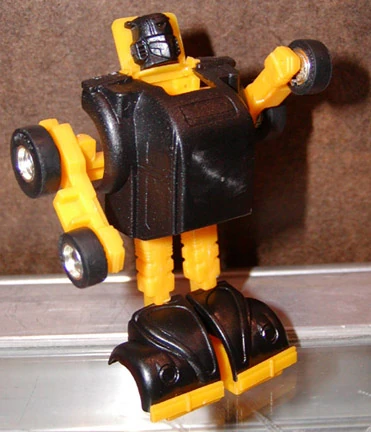

So, uh, Hasbro stuck Bumblebee's toy wheels on his Japanese Microman Microchange model kit for a totally unknown reason. This is the essence of "mock-up".
A prototype is a sample version of a manufactured object produced for internal use in the manufacturing process, before the official mass production run starts. Various sorts of prototypes exist, both for the toys themselves and for the packaging. Sometimes prototypes of Transformers toys end up in the possession of fans and collectors, but not always through entirely legal means.
Toy prototypes
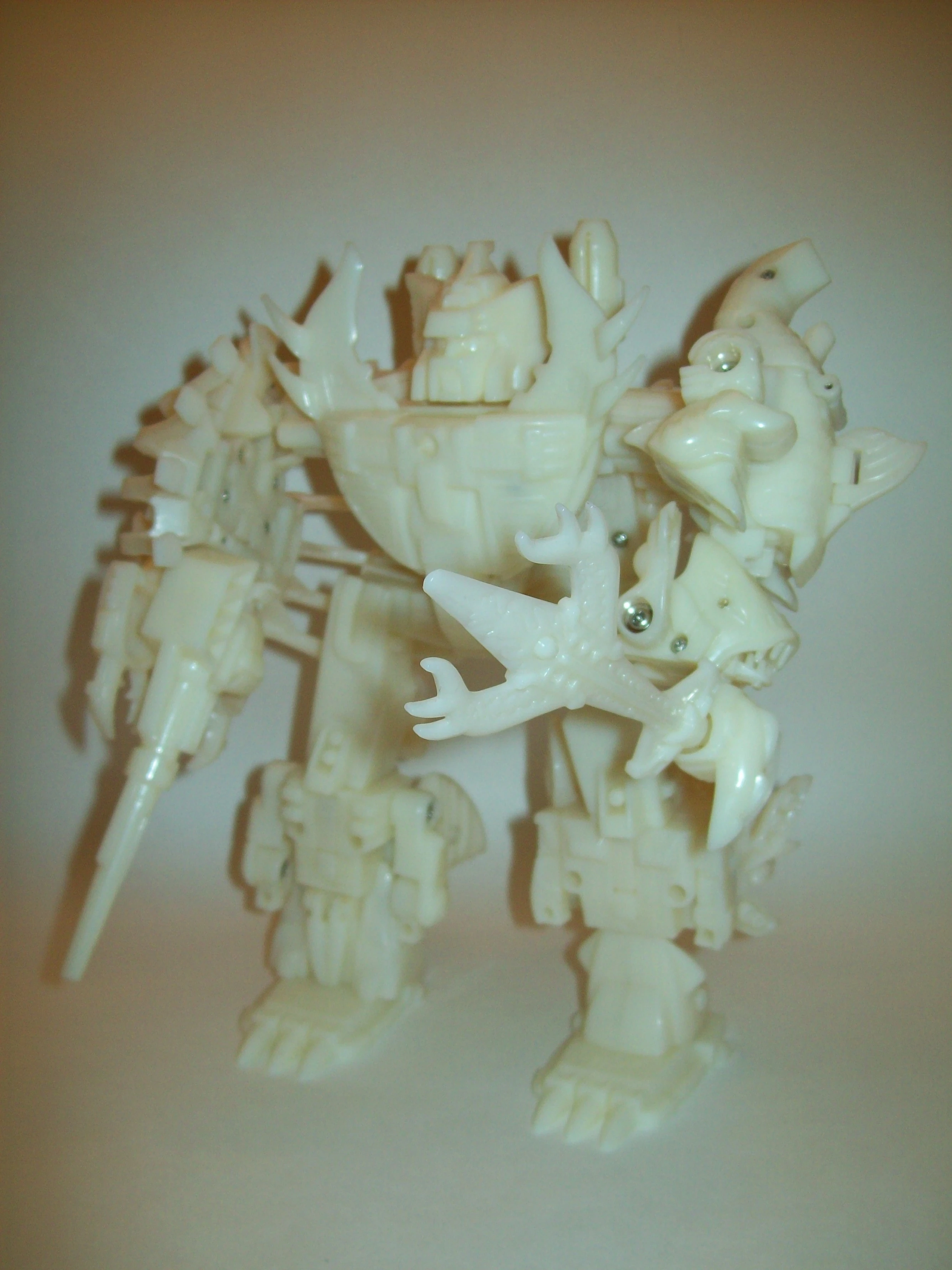

The ultimate snow camouflage.
- Mock-ups are rough models used to prove a design (not unlike fan-made kitbashes or "scratch-builts"), and may be significantly different from the finished product. They usually don't transform yet; instead, individual mock-ups are made for each mode. Sometimes mock-ups reuse parts from existing Transformers.
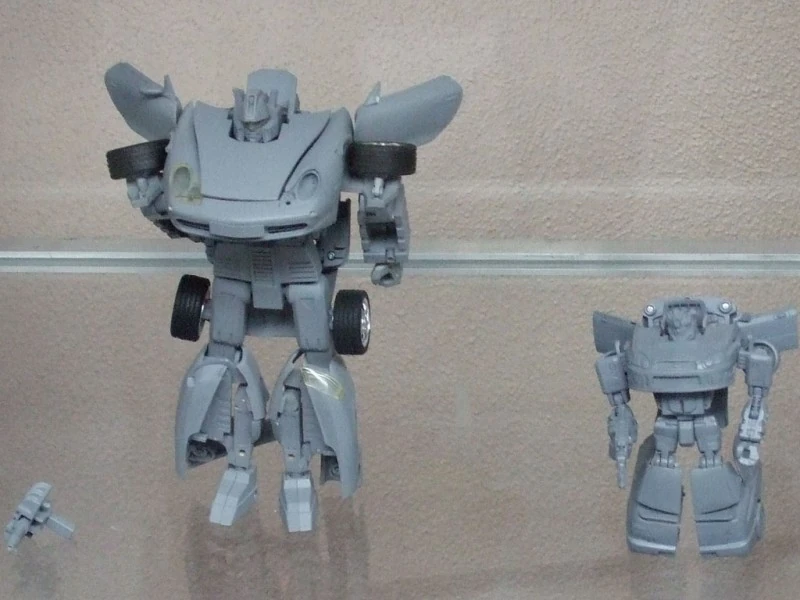

Good luck trying to find THESE guys.
- Hardcopies are hand-sculpted pre-production casts which are usually made out of resin (hence they're also occasionally referred to as resins) and are used as the basis from which the injection molds for the actual toys are cast. As a result, hardcopies often have very much sharper detail than the final products. Hand-painted hardcopies are also used for the promotional photos depicted on the toys' packaging, which is why those photos sometimes look different from the actual products.
- Test shots, also referred to as engineering pilots or first shots, are basically test runs of the injection molds to test the tooling and spot sculpting errors, test the plastic tolerances, the articulation, etc. Safety testing is also done with test shots, which sometimes results in the injection molds being retooled or the plastic type used for certain parts being changed in order to accommodate the changes demanded by the legal department. They are often cast in a single color of plastic, or in seemingly random colors that look nothing like the final products. Some are completely or partly made of clear (but not necessarily uncolored) plastic, which helps the designers observe the functioning of hidden parts. First shots do not sport any factory-applied paint applications yet.
- Pre-production samples, also referred to as final engineering pilots (and sometimes also as "test shots" among fans), are very similar to the final products. They are usually cast in the correct plastic colors for the individual parts (although sometimes the plastic colors or shades can still be changed very late in the production process, sometimes even after the production run for the toy has already started, thus resulting in a running change variant of the official production version) and feature factory-applied paint applications, and their primary purpose is to provide an idea of what the final toy will look like and receive final approval from the company (or possible licensors). They are also used as display exhibits at toy shows. In instances where the samples don't sport factory-applied paint applications yet, they are hand-painted. Because pre-production samples are that similar to the final product, they will often get stamped with "not for sale" markings or feature deliberately wrong paint applications (e.g., wrong, upside-down or incorrectly colored faction symbols) in order to prevent them being confused with the final product.
- Production samples are the final stage before the actual production run starts, and are virtually indistinguishable from the final products in most cases. They are packaged in sample packaging (see below), and people with good contacts to Hasbro sometimes receive production samples for review purposes.
Packaging prototypes
- Mock-up packaging is often made of a random piece of cardboard (sometimes any packaging from another line that happens to be available in Hasbro's offices at the moment) with a clear plastic tray and window (or, in the case of carded toys, a blister bubble). Its primary purpose is to get an idea of the intended shape of the packaging. The toy included in the mock-up packaging can be anything from a totally random toy from another line to a mock-up to a test shot or a pre-production sample.
- Proof packaging does not contain any toys, but merely serves to get an idea of the final packaging design. Proof cards for carded toys can range from being only printed on one side, lacking rounded edges and punch holes, to being virtually indistinguishable from the cardback for a production toy, only lacking a glued-on blister bubble. Sometimes the proof packaging can still feature differences from the final production versions, such as spelling or name errors, different graphics, logos or text fonts, or slightly different layouts for the various elements such as graphics, logos or text.
- Sample packaging is very close to the final product, and again can contain anything ranging from toys from different lines to test shots to pre-production samples.
Legalities
For various legal reasons, toy companies won't officially sell prototypes or any other kind of pre-production toys on the market. Since one of the purposes of test shots is safety-testing, they are technically not safety-tested yet, hence officially selling them could be a legal minefield. The designers and engineers at Hasbro and Takara are allowed to keep one or two pieces for their private collection, and sometimes it's possible for fans with contacts to (former) Hasbro employees to acquire test shots or pre-production samples of toys from older lines through legal means. Hardcopies, on the other hand, are a lot harder to come by, one of the reasons for this being their generally lower production numbers (only about ten hardcopies for a toy are made, whereas the number of test shots and samples easily reaches three-digit numbers). Stores will also sometimes receive samples (usually of the production variety) as a "preview". Furthermore, Hasbro will sometimes give out production samples to individuals for review purposes. Even though this isn't Hasbro's intention, those individuals are legally allowed to resell their samples on the aftermarket.
Officially, the vast number of test shots and pre-production samples (except those given out for "preview" or review purposes) are supposed to be dumped or destroyed once they have fulfilled their purpose (safety testing, approval from the company etc.). However, since most toy companies have been having their toys manufactured in China for almost two decades by now, and the factories aren't even directly owned by the toy companies themselves in most cases, it's hard for them to retain full control over the final fate of those pre-production items. As a result, factory employees who have realized that the toys they are helping manufacture aren't only bought by kids and their parents, but also by adult collectors, have started to make a habit out of smuggling various kinds of pre-production items (starting at the test shot stage) out of the factory and selling them to dealers who often specifically specialize in pre-production toys.
In the case of the Transformers toylines, this phenomenon started in the mid-1990s during the run of the Beast Wars line. A young Daniel Ross (aka Mouth04) was one of the first people who regularly made photos of production samples available to a growing Transformers online fandom, provided by an eBay seller going by the alias "SPQQKY".[1] Daniel later stated that it had never occurred to him that what SPQQKY was involved in was illegal in any way whatsoever until he provided packaging photos of the BotCon 2001 exclusive Tigatron toy, which at that time was still officially unrevealed. Initially, collecting pre-production toys had been a niche "market" reserved for people with established contacts to Chinese dealers. With the emergence of online auction sites such as eBay or the Chinese counterpart Taobao, however, it has become a lot easier for people to buy pre-production toys from (usually Chinese) sellers, hence making it more of a "mainstream" activity. That still doesn't mean that it's legal, however.
Toy companies usually refrain from explicitly referring to pre-production items sold on auction sites as "stolen", instead using rather vague phrases such as "obtained through unauthorized means".[2] For a brief time in 2003, Hasbro had maintained a strict policy explicitly demanding that fan sites must not post any "unsolicited materials", specifically photos of toys that had not been officially announced yet. However, they never provided specific guidelines they had promised (allegedly, this was because their legal team had come to the conclusion that they had no legal stand in this matter[3]), and by the end of the year, fan sites had completely stopped following that policy, supposedly with no legal repercussions whatsoever. In an interview[4], Aaron Archer stated that it could never be said with full certainty whether pre-production toys sold on auction sites had indeed been stolen, and other than having the auction taken down, there was not much Hasbro could do legally. One of the possible reasons for this is Hasbro's lack of ownership of the Chinese manufacturing plants, as well as the rather sketchy legal situation in China in general. A conspiracy theory among some fans even suggests that Hasbro deliberately "leak" test shots in order to evaluate the audience's reactions.
Brian Savage took a more direct approach when multiples of the BotCon 2008 exclusive toys were being sold on eBay before the convention, asking eBay to take down the auctions and sending e-mails to the sellers asking them to return the stolen toys (explicitly referred to as such) to him.
In order to make pre-production toys (mostly test shots and pre-production samples) less "attractive" to buyers, Hasbro have tried out all kinds of different methods, from the aforementioned "Not for sale" markings (which used to be etched in, but are now simply stamped on) to off-color paint applications to deliberately "damaging" the toys (often achieved by slapping ugly splotches of red paint all over the face). However, to some collectors, those efforts have the opposite effect, making them even more attractive in their eyes due to their apparent uniqueness. Possibly the most effective method employed by Hasbro thus far was individually marking the test shots with a screwdriver. Those markings would then help Hasbro in tracking down the source of the leak and cracking down on it.
Perhaps the most bizarre variety of Transformers prototypes that have surfaced thus far date from 2002, variants of the early Commemorative Series reissues cast almost entirely in clear plastic. Because the origin of these toys has never been explained in full capacity, fan theories ranged from genuine test shots to bootlegs to unauthorized "lunchtime" runs of the molds done by the same people that smuggled them out of the factory. The latter theory caused some fans to refer to those toys as "lunchtime specials". Some people insist that those toys are fully legit (but not necessarily legally acquired) prototypes created by Hasbro and Takara to serve as "reference pieces".